
How to Choose the Right Beam Angle for LED Downlights
Introduction
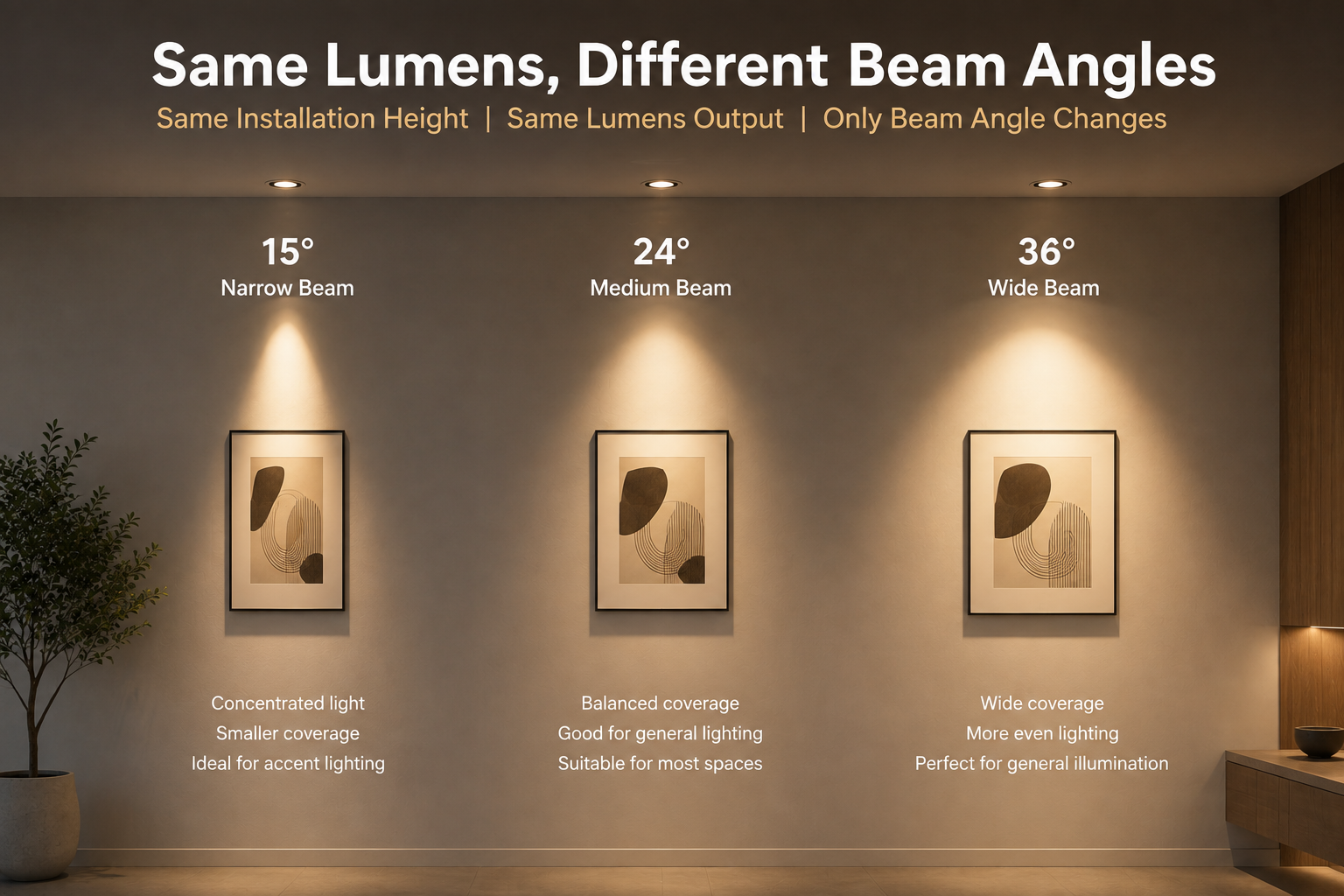
Beam angle plays an important role in how light is distributed within a space. Even if two LED downlights have the same lumen output, different beam angles can produce very different lighting effects.
Choosing the right beam angle helps create comfortable illumination, highlight important areas and improve the overall lighting layout.
1. What Is Beam Angle?
Beam angle is the angle at which light spreads from the fixture.
A narrow beam angle creates a concentrated light pattern, while a wide beam angle distributes light over a larger area.
Understanding this difference is the first step in selecting the right downlight.
2. Narrow Beam Angles for Accent Lighting
Narrow beam angles are commonly used when highlighting artwork, textured walls, decorative features or display areas.
They provide stronger visual focus and create more contrast within the space.
3. Wide Beam Angles for General Lighting
Wide beam angles spread light more evenly across the room.
They are often used for living rooms, offices, hotel rooms and other spaces that require comfortable ambient lighting.
4. Ceiling Height Also Matters
Beam angle should always be considered together with ceiling height.
Higher ceilings may require narrower beam angles to maintain sufficient brightness on the target area, while lower ceilings often work well with wider beam angles.
5. Balance Beam Angle with Lighting Layout
Rather than selecting beam angle alone, it should be planned together with fixture spacing, room function and lighting layout.
A balanced design creates comfortable, efficient and visually pleasing lighting.
Conclusion
There is no single beam angle suitable for every project.
The best choice depends on the room function, ceiling height and desired lighting effect.
Understanding how beam angle influences light distribution makes it easier to create balanced and efficient lighting for residential and commercial spaces.