
How to Space LED Downlights Correctly
Introduction
Proper downlight spacing is just as important as choosing the right fixture. Even high-quality LED downlights may create dark areas, uneven brightness or excessive glare if they are installed too close together or too far apart.
This guide explains the key factors that influence downlight spacing and how to achieve balanced lighting in residential and commercial projects.
Ceiling Height Matters
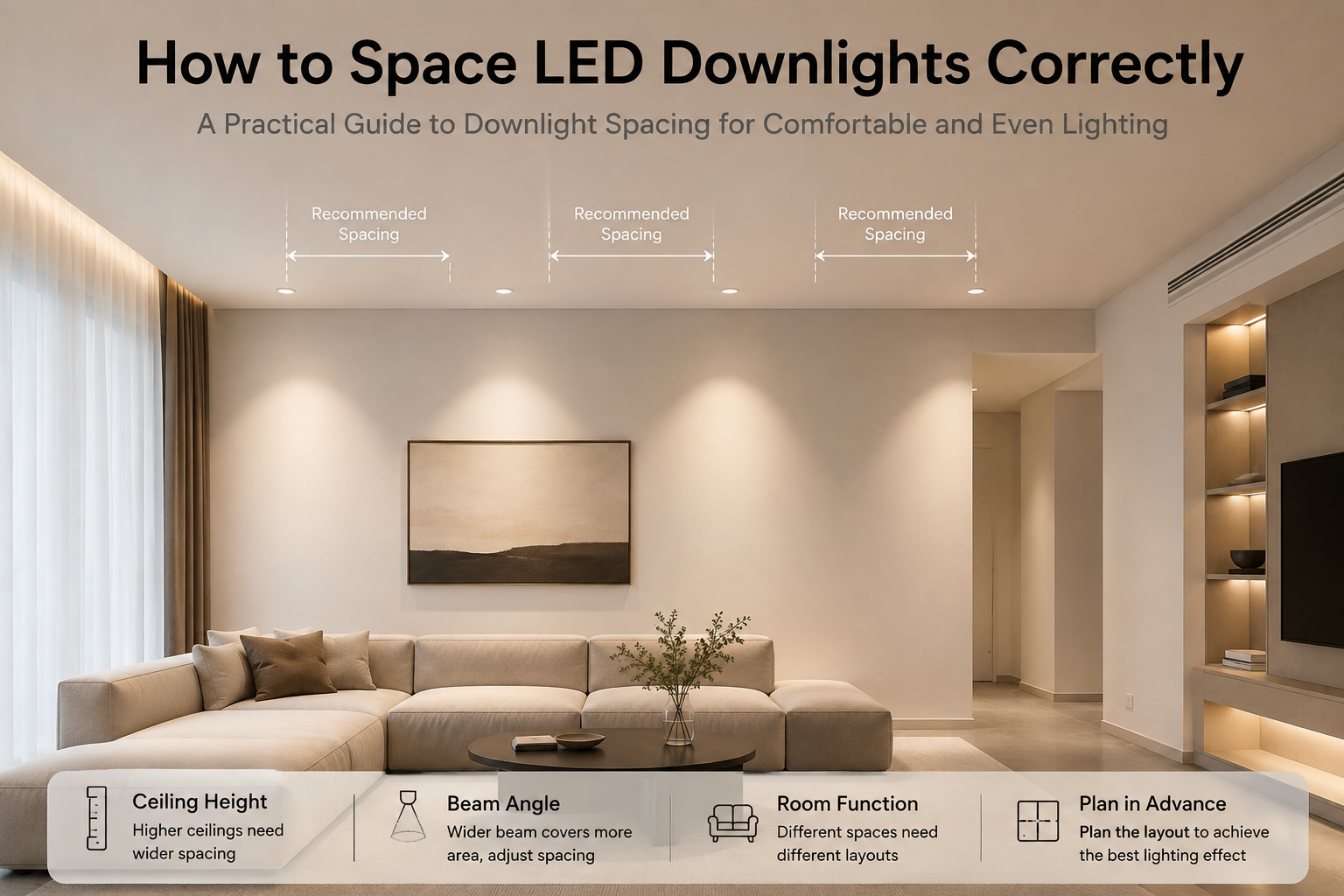
Ceiling height is one of the most important factors when determining downlight spacing.
Higher ceilings generally require wider spacing or different beam angles, while lower ceilings usually allow closer fixture placement for more even illumination.
Always consider ceiling height before deciding the lighting layout.
Beam Angle Affects Light Distribution
Beam angle determines how widely each downlight spreads light.
A wider beam angle covers a larger area, while a narrower beam angle concentrates light on a smaller space.
Matching beam angle with fixture spacing helps create smooth and consistent illumination.
Consider the Purpose of the Space
Lighting layout should always match the function of the room.
Living rooms usually focus on comfortable ambient lighting.
Offices require more uniform illumination for working.
Retail stores often combine general lighting with accent lighting.
Different applications may require different downlight spacing strategies.
Avoid Uneven Lighting
Placing fixtures too far apart may leave visible dark areas between lights.
Installing them too close together may create excessive brightness and unnecessary energy consumption.
Balanced spacing helps improve visual comfort while maintaining an efficient lighting layout.
Plan the Layout Before Installation
Before installation, consider the room dimensions, furniture arrangement and focal areas.
Planning the layout in advance helps avoid unnecessary repositioning and creates a cleaner lighting result.
For larger projects, reviewing a floor plan before selecting fixture locations is recommended.
Conclusion
Correct downlight spacing is achieved by balancing ceiling height, beam angle, room function and lighting layout rather than following a fixed measurement.
A well-planned lighting layout provides comfortable illumination, improves visual consistency and enhances the overall appearance of the space.