
How to Choose CCT, CRI and Beam Angle for LED Spotlights
Introduction
Selecting the right LED spotlight involves more than choosing the correct wattage.
Three specifications have the greatest impact on the final lighting effect: Color Temperature (CCT), Color Rendering Index (CRI), and Beam Angle.
These parameters influence how a space looks, how comfortable the lighting feels, and how accurately colors are displayed.
Understanding how they work together helps create lighting that is both functional and visually appealing.
Understanding Color Temperature (CCT)
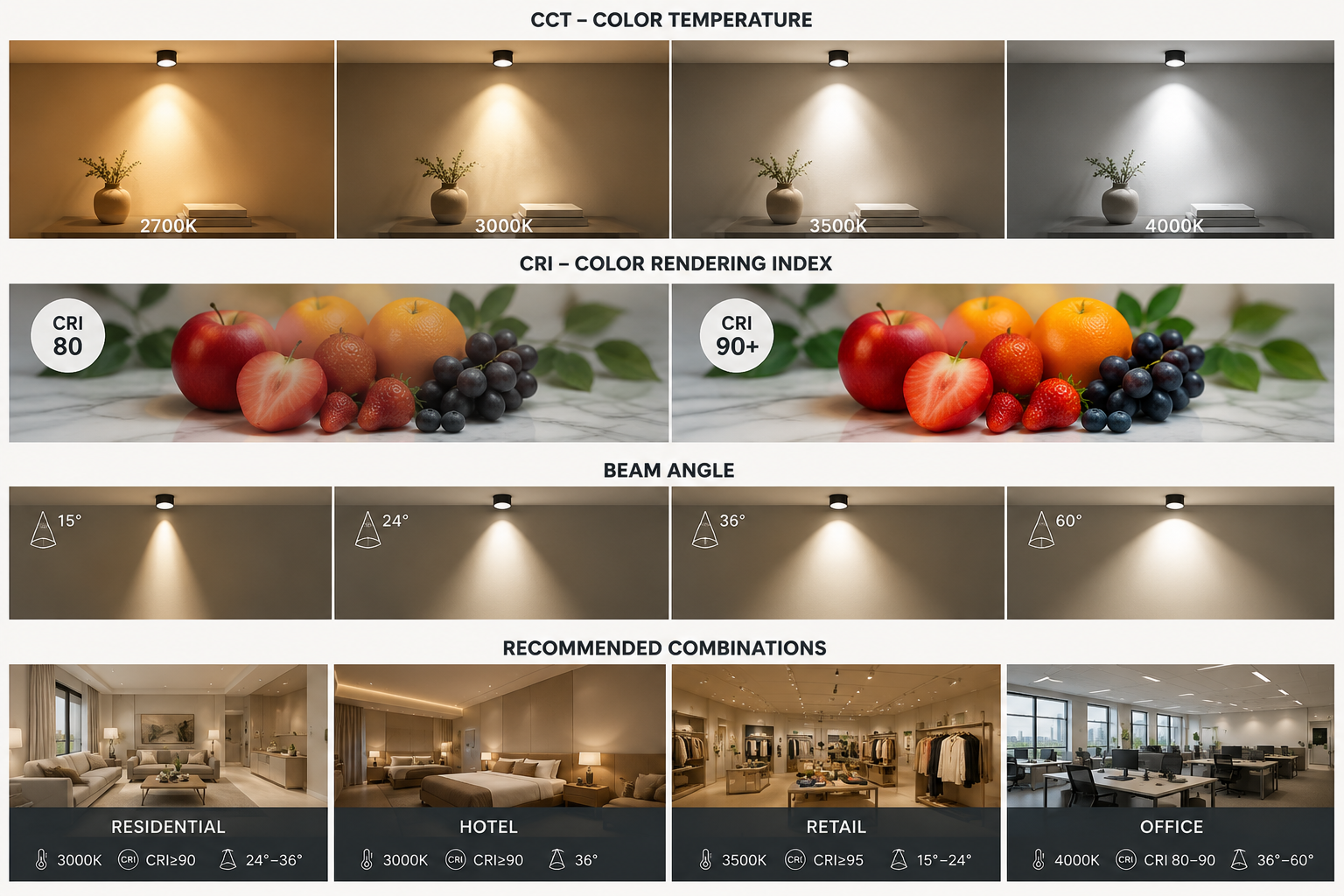
Color Temperature describes the color appearance of the light, measured in Kelvin (K). Different color temperatures create different atmospheres and are suitable for different applications.
2700K
2700K produces a warm, soft light that creates a relaxing atmosphere.
It is commonly used in bedrooms, luxury villas, boutique hotels and other spaces where comfort is the priority.
3000K
3000K is one of the most popular choices for residential and hospitality lighting.
It provides warm white illumination while maintaining good brightness, making it suitable for living rooms, restaurants and hotel guest rooms.
3500K
3500K offers a balance between warm and neutral white.
It is often selected for premium residential projects, hotel public areas and commercial interiors that require a modern but comfortable appearance.
4000K
4000K produces a neutral white light that appears brighter and cleaner.
It is widely used in offices, retail stores, clinics and commercial environments where visual clarity is important.
Understanding Color Rendering Index (CRI)
CRI measures how accurately a light source reveals the true colors of objects.
A higher CRI allows furniture, artwork and interior finishes to appear more natural.
CRI 80
Suitable for basic commercial lighting where color accuracy is not critical.
CRI 90
The most common choice for residential, hospitality and commercial projects.
It provides natural color reproduction while maintaining good efficiency.
CRI 95+
Recommended for applications where accurate color presentation is essential, such as luxury residences, galleries, museums, jewelry stores and premium retail displays.
Understanding Beam Angle
Beam angle determines how concentrated or how wide the light is distributed.
Choosing the correct beam angle is just as important as selecting the right lumen output.
15°
Produces a narrow beam that highlights artwork, sculptures and display products.
24°
Ideal for accent lighting, feature walls and decorative elements.
It provides stronger visual focus while maintaining comfortable illumination.
36°
A versatile beam angle suitable for most residential and hospitality applications.
It offers a balance between brightness and coverage.
60°
Provides wide light distribution and is commonly used for general lighting in larger spaces.
Recommended Combinations for Different Projects
Different projects require different combinations of CCT, CRI and beam angle.
Residential Homes
- CCT: 3000K
- CRI: ≥90
- Beam Angle: 24°–36°
This combination creates warm, comfortable lighting while maintaining natural color appearance.
Hotels
- CCT: 3000K
- CRI: ≥90
- Beam Angle: 36°
Suitable for guest rooms, corridors and public areas where visual comfort is essential.
Retail Stores
- CCT: 3500K
- CRI: ≥95
- Beam Angle: 15°–24°
Higher CRI helps products appear more attractive, while narrower beam angles create stronger visual focus.
Office Spaces
- CCT: 4000K
- CRI: 80–90
- Beam Angle: 36°–60°
Neutral white light improves visibility and creates a productive working environment.
Common Mistakes When Choosing LED Spotlights
Many buyers focus on a single specification while overlooking how all three parameters work together.
Some common mistakes include:
- Assuming higher color temperature always means brighter light.
- Choosing the highest CRI even when it is unnecessary.
- Using the same beam angle throughout the entire project.
- Ignoring ceiling height when selecting beam angles.
- Selecting spotlights based only on wattage.
Good lighting is achieved by balancing all specifications rather than maximizing one parameter.
Buying Tips
Before purchasing LED spotlights, consider the following questions:
- What atmosphere do you want to create?
- Is accurate color reproduction important?
- Will the spotlight provide general lighting or accent lighting?
- What is the ceiling height?
- Which beam angle best suits the application?
Evaluating these factors together helps create a lighting solution that is both comfortable and efficient.
Frequently Asked Questions
Which CCT is best for residential lighting?
For most homes, 3000K offers the best balance between warmth and brightness.
Is CRI 95 always better than CRI 90?
Not necessarily.
CRI 90 is sufficient for most residential and commercial applications, while CRI 95 is typically reserved for projects requiring exceptional color accuracy.
Does a smaller beam angle make the light brighter?
At the same lumen output, yes.
A narrower beam concentrates the light into a smaller area, resulting in higher illuminance.
Can different beam angles be used in the same room?
Yes.
Many professional lighting designs combine multiple beam angles to achieve both general illumination and accent lighting.
Conclusion
Choosing the right LED spotlight is not simply about selecting the highest specifications.
The best lighting design combines the appropriate CCT, CRI, and beam angle according to the function of the space.
By understanding how these three parameters work together, homeowners, designers and project buyers can create lighting that is comfortable, visually balanced and suited to the specific application.