
IP44 vs IP65 LED Spotlights: Which One Should You Choose?
Introduction
Choosing the correct IP rating is an important part of selecting LED spotlights for residential and commercial projects.
Many buyers assume that a higher IP rating is always better. However, this is not necessarily true.
Using an IP65 spotlight where IP44 is sufficient may increase costs without providing additional benefits. On the other hand, choosing a lower IP rating for wet environments may reduce the product’s long-term reliability.
Understanding the difference between IP44 and IP65 helps ensure the spotlight matches the installation environment.
What Does an IP Rating Mean?
IP stands for Ingress Protection, an international standard that indicates how well a lighting fixture is protected against dust and water.
The first digit refers to protection against solid objects and dust, while the second digit refers to protection against moisture and water.
For indoor LED spotlights, IP44 and IP65 are the two most commonly used protection levels.
What Is an IP44 LED Spotlight?
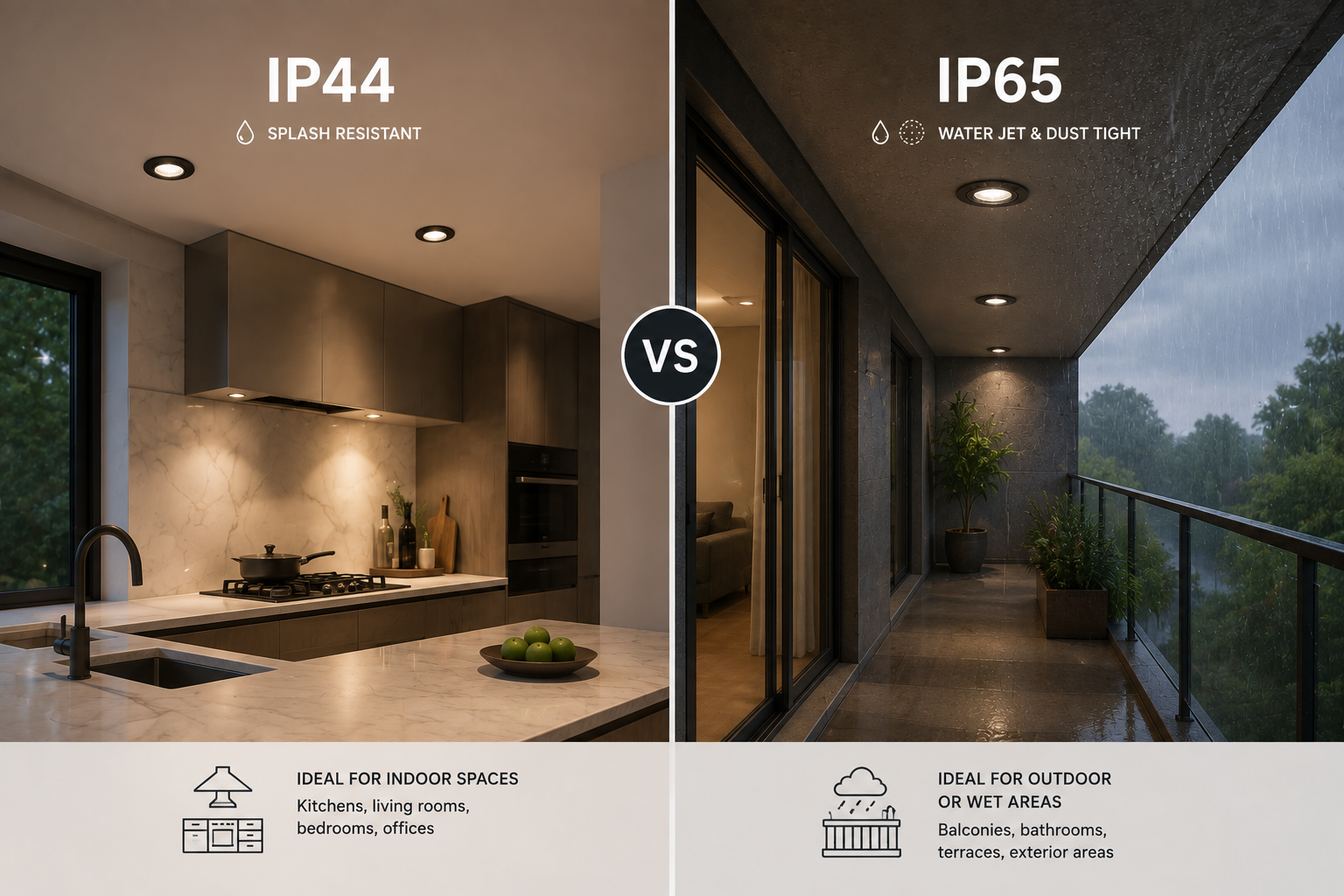
An IP44 spotlight is protected against solid objects larger than 1 mm and water splashes from any direction.
It is suitable for most indoor areas where the fixture is not directly exposed to heavy water or dust.
Typical Applications
- Living rooms
- Bedrooms
- Dining rooms
- Hotel guest rooms
- Offices
- Dry commercial interiors
For these environments, IP44 generally provides sufficient protection while maintaining a cost-effective solution.
What Is an IP65 LED Spotlight?
An IP65 spotlight provides complete protection against dust and is resistant to low-pressure water jets.
It is designed for environments where moisture, condensation or frequent cleaning is expected.
Typical Applications
- Bathrooms
- Shower areas
- Kitchens
- Covered balconies
- Hotel bathrooms
- Spa facilities
- Commercial washrooms
For projects exposed to higher humidity, IP65 improves durability and long-term performance.
IP44 vs IP65: Key Differences
Instead of focusing only on specifications, buyers should consider the installation environment.
IP44
- Splash-resistant
- Suitable for dry indoor spaces
- Lower cost
- Common for residential lighting
IP65
- Dust-tight
- Water-jet resistant
- Suitable for humid environments
- Better protection for demanding applications
Which One Should You Choose?
The correct choice depends on where the spotlight will be installed.
Residential Living Room
Recommended: IP44
Bedroom
Recommended: IP44
Bathroom Ceiling
Recommended: IP65
Kitchen
Recommended: IP65
Especially when the spotlight is installed near cooking or washing areas.
Hotel Guest Room
Recommended: IP44
Hotel Bathroom
Recommended: IP65
Retail Store
Most indoor retail projects use IP44 unless the environment requires additional protection.
Common Mistakes When Choosing IP Ratings
Many projects make unnecessary purchasing decisions because of common misunderstandings.
Some examples include:
- Assuming IP65 is always better than IP44.
- Using IP44 in wet environments.
- Selecting IP65 for every indoor room without considering actual conditions.
- Ignoring the installation location within the same building.
Choosing the correct IP rating helps balance cost, performance and durability.
Buying Tips
Before selecting an IP rating, ask the following questions:
- Will the spotlight be exposed to water splashes?
- Is the environment humid?
- Will the fixture be cleaned frequently?
- Is the installation indoors or semi-outdoors?
Matching the IP rating to the actual application is usually more important than simply choosing the highest specification.
Frequently Asked Questions
Is IP65 brighter than IP44?
No.
Brightness depends on the LED and optical design, not the IP rating.
Can IP65 be used indoors?
Yes.
However, for dry indoor areas, IP44 is often sufficient and more economical.
Is IP44 suitable for bathrooms?
Only in certain dry zones.
Areas exposed to water or high humidity should generally use IP65 fixtures.
Does a higher IP rating mean better quality?
Not necessarily.
IP rating only indicates protection against dust and water.
Overall product quality also depends on the LED, driver, heat dissipation and optical design.
Conclusion
IP44 and IP65 LED spotlights are designed for different installation environments.
IP44 is suitable for most dry indoor applications, while IP65 provides additional protection for humid or wet locations.
Selecting the correct IP rating helps improve product reliability, avoid unnecessary costs and ensure the lighting system performs as expected throughout its service life.