
Why Do Two 1000-Lumen Lights Look So Different?
This is because lumen is usually the first specification buyers check when choosing a light fixture.
Lumen is essential because it measures the total luminous flux a fixture emits.
However, in real-world lighting projects, lumen output alone does not determine the final visual result.
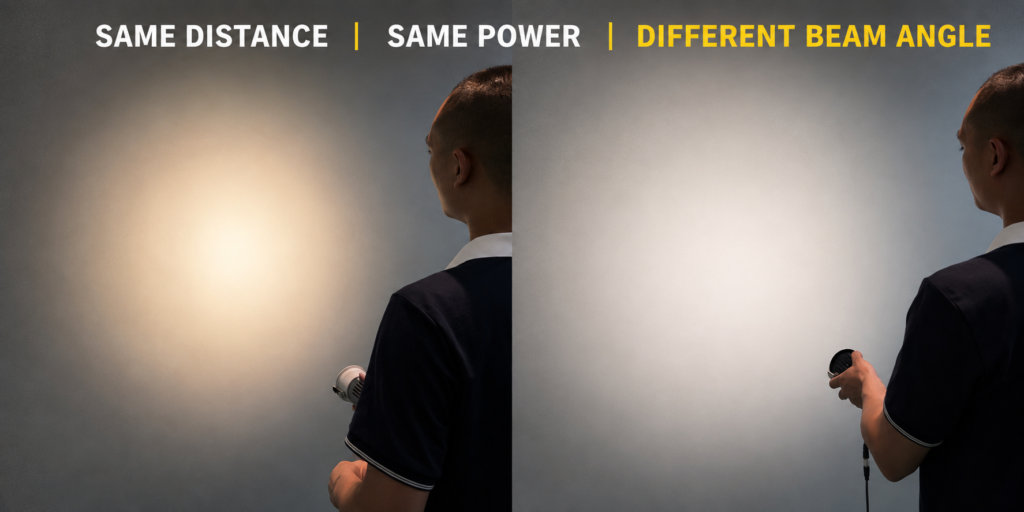
Two fixtures with the exact same 1000 lumens can still look completely different depending on beam angle, mounting height, and light distribution.
Section 1: Lumen Is Not the Final Result
Lumen only tells us how much light a fixture produces-it does not tell us how bright the space will actually feel.
For example, a narrow beam light concentrates light into a smaller area, creating a stronger accent illumination.
Conversely, a wide beam angle spreads light over a larger area, producing a softer and more uniform wash.
That is why identical lumen ratings can yield completely different visual effects on a desk, a wall, or a floor.
Section 2: What Really Affects the Experience?
In professional lighting design, we never look at lumens in isolation. We also evaluate illuminance, luminance, beam angle, light distribution, and mounting conditions.
- Illuminance (Lux): Measures how much light actually reaches a surface.
- Luminance: Describes how bright a surface appears to the human eye.
- Beam Angle: Determines whether light is focused or broadly diffused.
- Light Distribution: Defines how the fixture spreads light across a space.
- Mounting Height: Directly impacts coverage. Higher mounting spreads light more broadly, while lower mounting positions create higher localized intensity.
Section 3: Why Do Some Spaces Feel More Comfortable?
Beyond the fixture itself, surface colors and material reflectance heavily influence the overall ambiance.
Light-colored, high-reflectance surfaces bounce light back into the room, making the space feel brighter and more open.
Dark, light-absorbing materials soak up light, creating a calmer atmosphere-though potentially making the room appear darker if not lit properly.
Ultimately, high-end lighting design is never about chasing the highest technical specs; it is about delivering light precisely where it is needed.
Conclusion
If Lumen represents how much light a fixture emits,
then Illuminance represents where that light lands,
and Luminance represents how bright the scene actually looks to the eye.
A truly professional lighting plan never relies on a single metric. It balances spatial function, optics, mounting height, and surface reflectance.
Great lighting is not just about brightness-it is about creating visual comfort for the space.