
How Anti-Glare LED Spotlights Improve Lighting Comfort
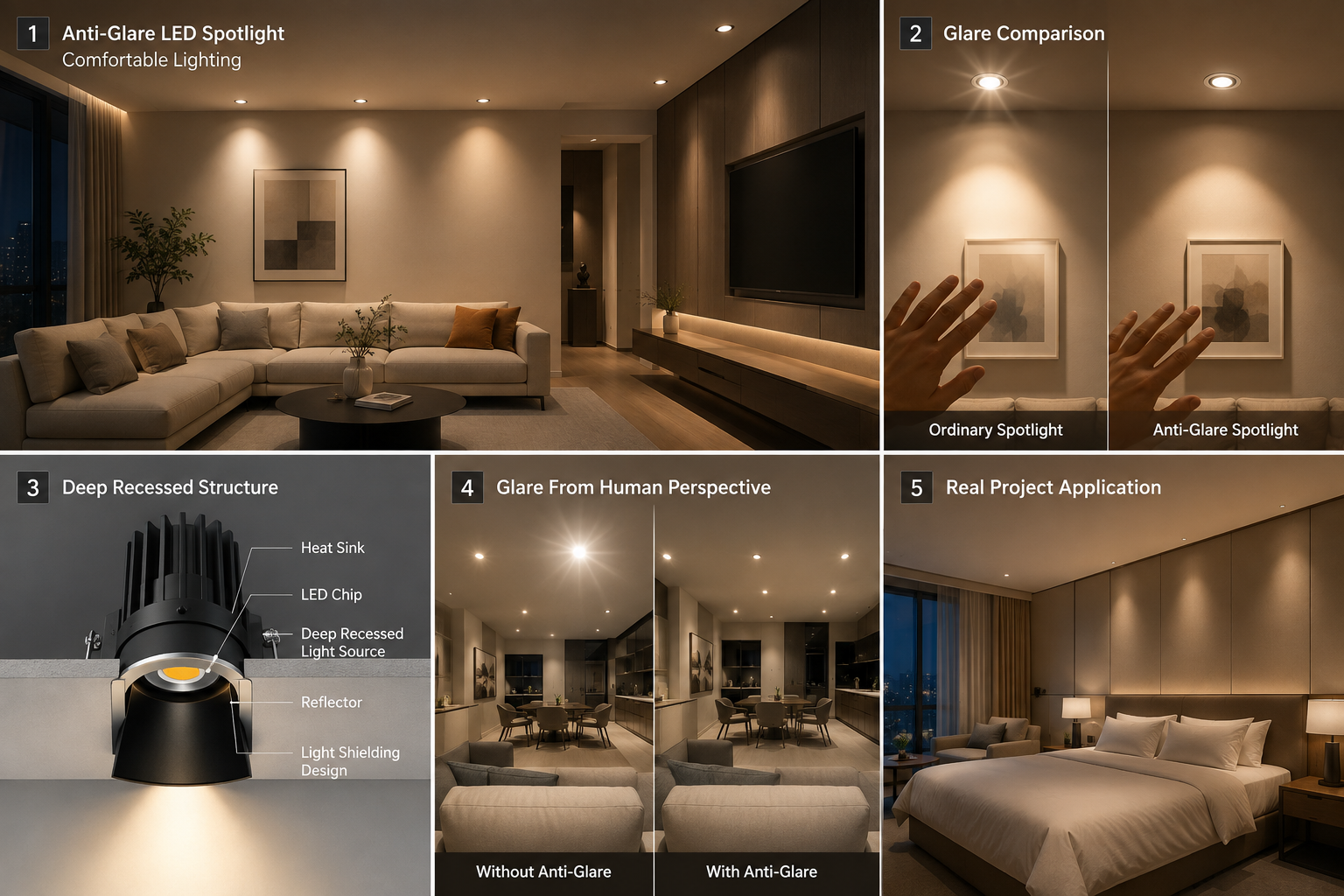
Introduction
Many people believe that brighter lighting always means better lighting.
However, in professional lighting design, visual comfort is often more important than brightness itself.
A spotlight with excessive glare can make a room feel uncomfortable even if the illumination level is appropriate. On the other hand, a well-designed anti-glare LED spotlight creates a softer, more comfortable environment while maintaining excellent lighting performance.
This article explains how anti-glare LED spotlights work, why they improve visual comfort, and how to choose the right solution for residential and commercial lighting projects.
What Is Glare?
Glare occurs when the human eye is exposed to excessive brightness or an exposed light source.
Instead of seeing the illuminated object, the eyes are distracted by the light itself.
This often causes visual discomfort, eye fatigue, and reduced lighting quality, especially in living rooms, hotels, restaurants, offices and retail spaces.
Good lighting should highlight the space—not the light source.
What Makes a Spotlight Anti-Glare?
An anti-glare spotlight is not simply a dimmer spotlight.
Instead, it controls how the light reaches the eyes.
Several design elements contribute to glare reduction:
- Deep recessed light source
- Deep reflector design
- Precision optical lens or reflector
- Controlled beam angle
- Proper shielding of the LED chip
These features reduce direct exposure to the light source while maintaining efficient illumination.
Why Anti-Glare Matters
Lighting comfort affects how people experience a space.
In residential environments, anti-glare spotlights create a relaxing atmosphere.
In hotels, they improve guest comfort.
In offices, they reduce eye fatigue during long working hours.
In retail stores, they help customers focus on products rather than the lighting fixtures.
Good lighting is comfortable because people hardly notice the light source itself.
Common Mistakes
Many buyers focus only on brightness or wattage while overlooking glare control.
Common mistakes include:
- Choosing the highest lumen output
- Ignoring reflector depth
- Selecting fixtures based only on price
- Using narrow beam angles without considering viewing direction
- Overlooking UGR or optical design
Comfort depends on lighting quality, not simply brightness.
How to Choose an Anti-Glare Spotlight
When selecting an anti-glare LED spotlight, consider the following factors:
- Deep recessed light source
- High-quality reflector or lens
- Appropriate beam angle
- High CRI (Ra90 or above)
- Stable flicker-free driver
- Suitable installation height
These elements work together to create comfortable and professional lighting.
Frequently Asked Questions
Does anti-glare reduce brightness?
No. Anti-glare technology controls how light reaches the eyes without significantly reducing useful illumination. A well-designed anti-glare spotlight can still provide excellent brightness while improving visual comfort.
Are anti-glare LED spotlights suitable for residential lighting?
Yes. They are widely used in living rooms, bedrooms, dining areas and villas because they create a more comfortable lighting environment and reduce direct glare.
Is a deeper reflector always better?
Not necessarily. A deeper reflector usually helps reduce glare, but overall optical design, beam control and reflector quality are equally important for achieving comfortable lighting.
What beam angle works best with anti-glare spotlights?
There is no single best beam angle. Narrow beam angles are ideal for accent lighting, while wider beam angles are better for general illumination. The right choice depends on ceiling height, installation spacing and the lighting objective.
Is UGR the only way to evaluate glare?
No. UGR is an important reference, but reflector design, recessed light source, optical system, beam angle and installation position also affect visual comfort. A complete lighting design considers all of these factors rather than relying on a single specification.
Conclusion
Comfortable lighting is not achieved by increasing brightness.
It is achieved by controlling how light interacts with the human eye.
Anti-glare LED spotlights improve visual comfort by combining optical design, beam control and proper shielding of the light source.
For residential, hospitality and commercial projects, selecting the right anti-glare spotlight creates a space that feels comfortable, clean and professionally illuminated.